There are two ways to take M-Pesa on a website. You connect it straight to Safaricom through Daraja, Safaricom’s platform for connecting websites and apps to M-Pesa, using your own Paybill or Till. Or you use a payment gateway: a company that collects the payment for you and pays you out.
Connecting a website to either one is routine work. What differs is whose number the money lands in, whether you can take cards, what it costs, when you get the money, and the paperwork.
Fees and payout times as each provider published them on 23 September 2026.
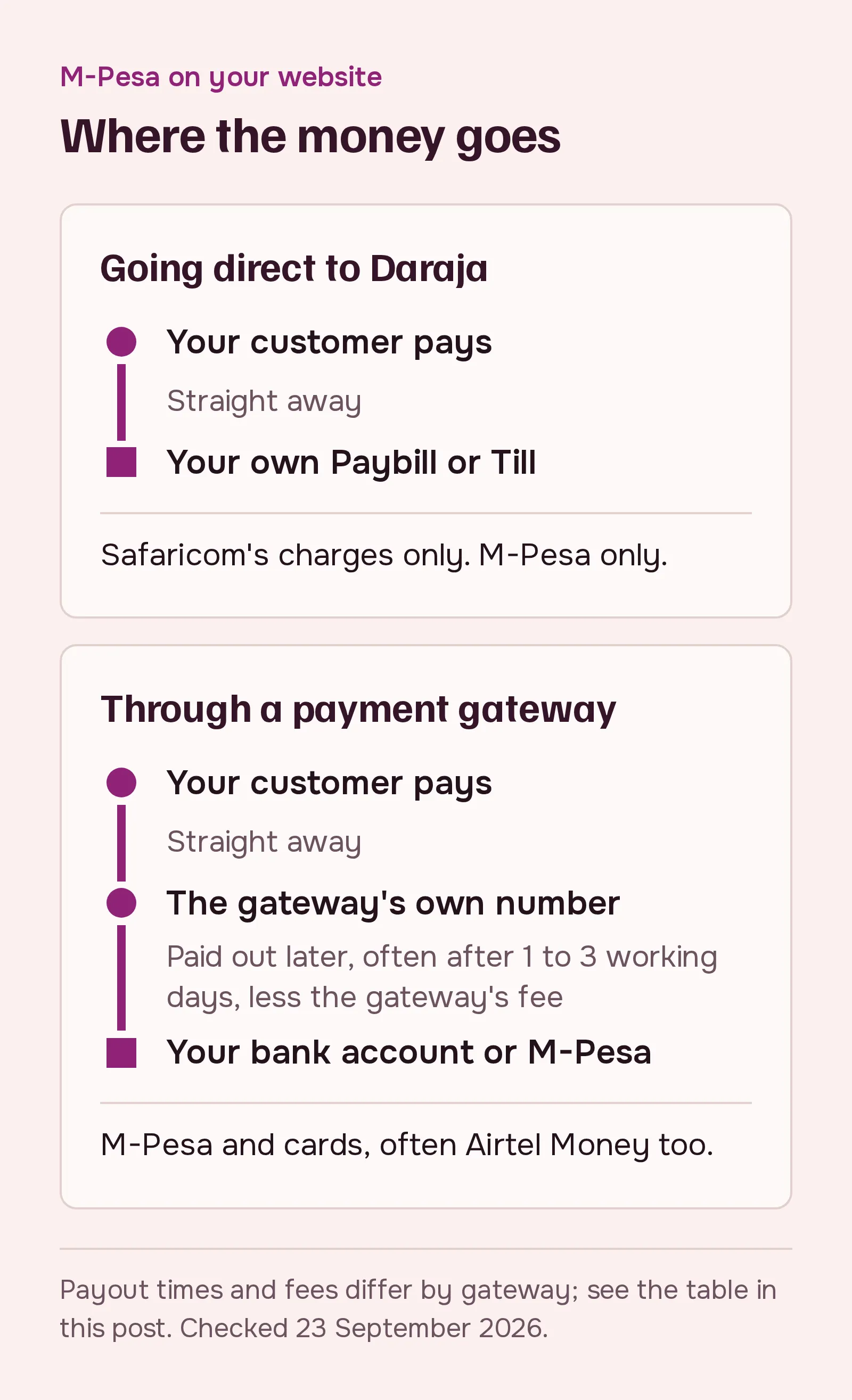
Going direct to Daraja
- The money lands in your own Paybill or Till straight away.
- You pay Safaricom’s normal Paybill or Till charges. We haven’t found any Safaricom fee for using Daraja itself.
- It’s M-Pesa only: no cards and no Airtel Money.
- You need a Paybill or Till, and the paperwork that comes with it: here’s the full list.
Through a payment gateway
- Customers can pay by M-Pesa or by card, and often by Airtel Money too.
- The money goes to the gateway first, and the gateway pays it out to your bank or M-Pesa later.
- The gateway takes a percentage of each payment.
- Some accept businesses that aren’t registered yet, with limits. Paystack’s Starter accounts need an ID and an account to be paid into, and can collect up to KES 600,000 in total. IntaSend doesn’t ask freelancers for business registration.
What the gateways charge
Published Kenyan fees, as we found them on 23 September 2026:
| Gateway | M-Pesa | Local cards | International cards | You’re paid |
|---|---|---|---|---|
| Paystack | 1.5% | 2.9% | 3.8% | automatically, after 2 working days |
| Flutterwave | 2.9% | 3.2% | 4.8% | the next day |
| IntaSend | 3% | 3.5% | 4.5% | when you withdraw, up to 3 working days later |
| Kopo Kopo | nothing up to KES 500, then 0.55%, at most KES 200 | no cards | no cards | when you withdraw |
Flutterwave’s prices exclude VAT. Pesapal, DPO Pay and Equity’s Jenga don’t publish their fees, so ask them for a quote.
These figures change. Check the provider’s own pricing page before you sign.
Check the licence
The Central Bank of Kenya authorises payment service providers and publishes the list. Look for the company you’re signing with on it. On the August 2026 list we found Paystack Payments Kenya, Pesapal, Direct Pay (DPO Pay) and Finserve Africa (Equity’s Jenga). Some providers work through licensed partners instead; ask them to explain how theirs works.
Card payments come with their own rules
A cardholder can dispute a card payment after the fact, and the business usually bears the cost if the dispute succeeds. This is called a chargeback. Some gateways also hold back part of your card income for months as a reserve: DPO Pay’s FAQ describes a rolling reserve, usually released after 180 days. Ask about both before you start taking cards.
Our suggestion
- If you only need M-Pesa and your paperwork is in order, go direct. The money is yours straight away, and you pay only Safaricom’s charges.
- If you need cards, sell to people outside Kenya, or aren’t registered yet, use a gateway.
- Some businesses do both: M-Pesa direct, and a gateway for cards.
If you’re not sure which is right for you, or you’d like us to set it up, talk to us. And if you’re going direct, Paybill or Till is the next choice to make.
Sources
- Safaricom Daraja, Getting started
- Paystack: fees, account types and documents and payouts
- Flutterwave, Kenya pricing
- IntaSend: pricing and payment links
- Kopo Kopo, charges
- Pesapal, business FAQs
- DPO Pay, FAQs
- Central Bank of Kenya, Directory of Authorized Payment Service Providers, 10 August 2026